If you picture New Canaan as all classic New England architecture, its modern side may come as a surprise. Yet this town became one of the most important settings for mid-century modern residential design in the country, and that legacy still shapes how many buyers experience it today. If you are curious about what makes these homes special, how they fit into the local landscape, and what to keep in mind if you hope to own one, you are in the right place. Let’s dive in.
Why New Canaan Matters in Mid-Century Modern Design
New Canaan’s reputation as a modernist hub did not happen by accident. After World War II, the town offered large former farmland parcels, close access to New York City, and the kind of setting that invited architectural experimentation. According to the Glass House survey, that combination helped turn New Canaan into a center for Modern residential design.
A major part of that story is the group often called the Harvard Five: Marcel Breuer, Landis Gores, John Johansen, Eliot Noyes, and Philip Johnson. They had studied under Walter Gropius at Harvard and then built and promoted their own homes in town. Their work helped establish New Canaan as a place where bold modern ideas could move from theory into daily life.
The scale of that influence was significant. Public sources note that more than 30 modern houses had been built in New Canaan by the end of 1952, and more than 100 were built by the end of the 1970s. The New Canaan Museum & Historical Society similarly reports that more than 100 modern homes were built between 1949 and 1973.
What Makes These Homes Distinctive
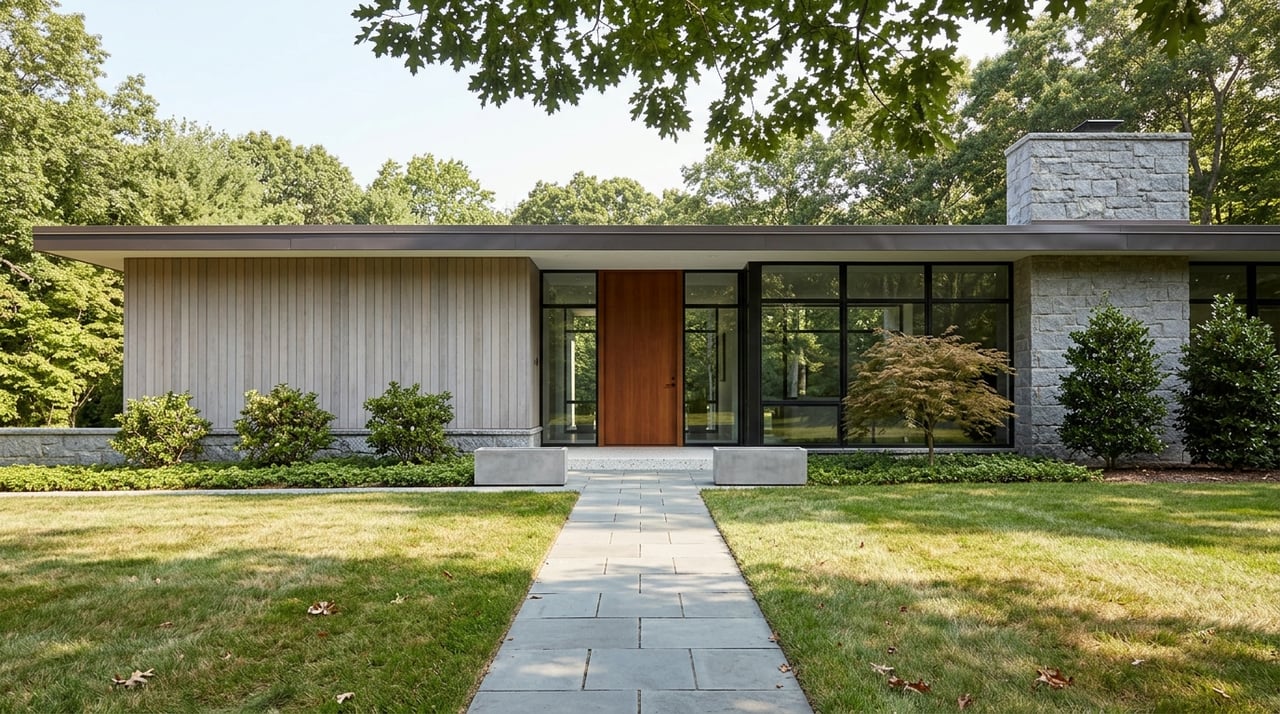
Mid-century modern homes in New Canaan tend to share a clear design language. You will often see flat or low roofs, strong horizontal lines, full-height glass walls, and open interior plans. Built-in storage, natural materials, and close visual ties to the landscape are also common features.
These homes were designed to feel connected to their sites rather than imposed on them. Instead of treating the yard as something separate, the architecture often frames trees, stone, ponds, and changing light as part of everyday living. That indoor-outdoor relationship is one of the qualities many buyers find most compelling.
The Landis Gores House offers a useful local example of the style. Its preservation record describes a flat-roofed, single-story, horizontal, glass-walled, open-plan home softened with natural wood and stone. That description captures the balance that makes many of these homes so livable: crisp geometry paired with warm materials.
The Glass House as a Local Reference Point
When people think of modern architecture in New Canaan, the Glass House is often the first property that comes to mind. The site describes it as a pavilion for viewing the landscape, set on a promontory above a pond and woods and hidden from the road. Its transparency and siting helped define a new way of thinking about residential design.
What is especially striking is that even with very few interior walls, the home still reads as a sequence of recognizable domestic spaces. In other words, the architecture is radically modern, but the experience of living in it still connects to familiar ideas of home. That tension between innovation and comfort helps explain why New Canaan’s modern houses remain so fascinating.
How Modern Homes Fit Into New Canaan Today
One of the most interesting things about New Canaan is that its modern architecture is not isolated in a single district of look-alike homes. Public descriptions show a pattern of private, wooded sites with houses set back from the road. That means these properties often feel discovered rather than displayed.
The museum does not publish a complete street-by-street map of modern houses, in part because of privacy. Still, official descriptions make it clear that many of these homes sit on generous lots and were carefully oriented to their surroundings. The result is a residential landscape where architecture and site planning work together.
At the same time, modern homes are only one part of New Canaan’s architectural identity. The town also includes much older buildings, including structures from the 18th and 19th centuries maintained by the New Canaan Museum & Historical Society. That contrast is part of the appeal: colonial-era buildings, mid-century modern landmarks, and later homes all coexist within the same community.
A Living Preservation Story
New Canaan’s modernist legacy is not just a chapter in the past. The museum’s Modern New Canaan initiative includes lectures, exhibitions, Modern House Day tours, a list of documented modern homes, and an index of demolished houses. That ongoing work reflects continued interest in both the architecture itself and the preservation of what remains.
This matters because preservation sources show that many modern homes were vulnerable to demolition in the 1990s and early 2000s. Education efforts, historic recognition, and zoning changes all played a role in helping preserve important examples. For buyers, that history adds another layer of meaning to ownership.
What Buyers Should Consider
Buying a mid-century modern home in New Canaan is often about more than square footage or bedroom count. For many buyers, the real draw is architectural stewardship, natural light, privacy, and a layout that feels deeply tied to the land. These homes can offer a very different experience from more conventional suburban houses.
If you are considering one, it helps to think about how you want to live in the home, not just how it looks in photos. Open plans, large expanses of glass, and strong site orientation can feel inspiring, but they also shape how rooms function, how furnishings fit, and how the house responds to seasonal light. A thoughtful match between the house and your lifestyle is important.
Renovation should also be approached carefully. Preservation sources suggest that the strength of these homes often lies in their original composition, materials, and relationship to the site. In practical terms, buyers usually benefit from thinking about updates in a way that respects the architecture rather than overwhelms it.
Check for Historic Status and Local Review
Before making plans for changes, it is smart to understand whether a property has any formal historic designation or review requirements. The New Canaan Museum notes that the Glass House and Rogers Studio are the town’s two National Historic Landmarks. The Glass House site also states that the Glass House, Gores Pavilion, and Hodgson House are listed on the National Register of Historic Places.
A town planning document adds another practical point. Exterior work in a local historic district requires a Certificate of Appropriateness. The same document notes that one-story modern homes can sometimes be disadvantaged by standard lot-coverage rules, which is another reason local guidance matters early in the process.
Who These Homes Often Appeal To
Mid-century modern homes in New Canaan tend to attract buyers who value design as much as daily function. If you appreciate clean lines, strong natural light, wooded privacy, and architecture that feels intentional in every detail, these homes may be a natural fit. They often appeal to people who see a house as both a living space and a design statement.
That does not mean every buyer will prefer this style. Some people want more formal room separation, more traditional detailing, or a different relationship between house and landscape. The key is to understand that New Canaan offers architectural range, and its modern homes represent one of the most distinctive options in the market.
Why Local Guidance Matters
Because these properties are so individual, buying one often requires a more tailored approach than buying a more typical home. Inventory can be limited, conditions and alterations can vary widely, and each property brings its own design, site, and zoning considerations. That is where local experience can make a real difference.
A buyer who understands the architecture but also wants practical advice on value, preservation context, and municipal considerations will usually benefit from working with someone who knows New Canaan closely. With the right guidance, you can evaluate not just the beauty of a home, but how well it supports your long-term goals.
If you are thinking about buying or selling a distinctive home in New Canaan, Janis Hennessy offers the calm, local guidance and bespoke service that help complex properties find the right fit.
FAQs
What makes New Canaan important for mid-century modern homes?
- New Canaan became a major center for modern residential design after World War II because of its proximity to New York City, available land, and the influence of the Harvard Five architects, with more than 100 modern homes built from the late 1940s into the 1970s.
What architectural features define New Canaan mid-century modern homes?
- Common features include flat or low roofs, horizontal lines, full-height glass walls, open plans, built-in storage, natural materials like wood and stone, and a strong connection to the surrounding landscape.
Are New Canaan modern homes all located in one neighborhood?
- No. Public descriptions suggest they are spread across private, often wooded residential sites rather than concentrated in a single showcase enclave.
What should buyers consider before renovating a New Canaan modern home?
- Buyers should consider the home’s architectural integrity, whether it has any formal historic designation, and whether local review rules such as a Certificate of Appropriateness may apply to exterior changes.
Are there still many mid-century modern homes in New Canaan today?
- Counts vary by source and criteria, but preservation records show that many remain, even though some were demolished or altered over time.
Why do buyers seek out New Canaan mid-century modern properties?
- Many buyers are drawn to the originality of the design, the natural light, privacy on wooded lots, and the experience of living in a home that closely integrates architecture and landscape.
